
Sliding Doors, but good
Low profile defenders, butchering a language, and Kermit the Frog.
In 1998, writer and director Peter Howitt released Sliding Doors to mixed reviews, commercial success, and the dismay of Australian football fans several decades later.
Much like 2007’s The Bucket List, the titular premise of the film has become such a mainstay in modern vernacular it’s hard to imagine a world without the concept.
A seemingly inconsequential occurrence drastically altering the trajectory of the future? That’s a sliding doors moment.
More recently, the ‘inconsequential’ element has fallen away from the definition, with people now taking the phrase to mean any notable fork in the road.
However, one use of the term that has never, ever been correct is the one ham-fistedly deployed by Damian Barrett each week, as he reverse engineers his passing thoughts into 18 illegible ‘if-then’ statements.
Take his effort from April, summing up West Coast’s 21 goal hiding at the hands of Sydney.
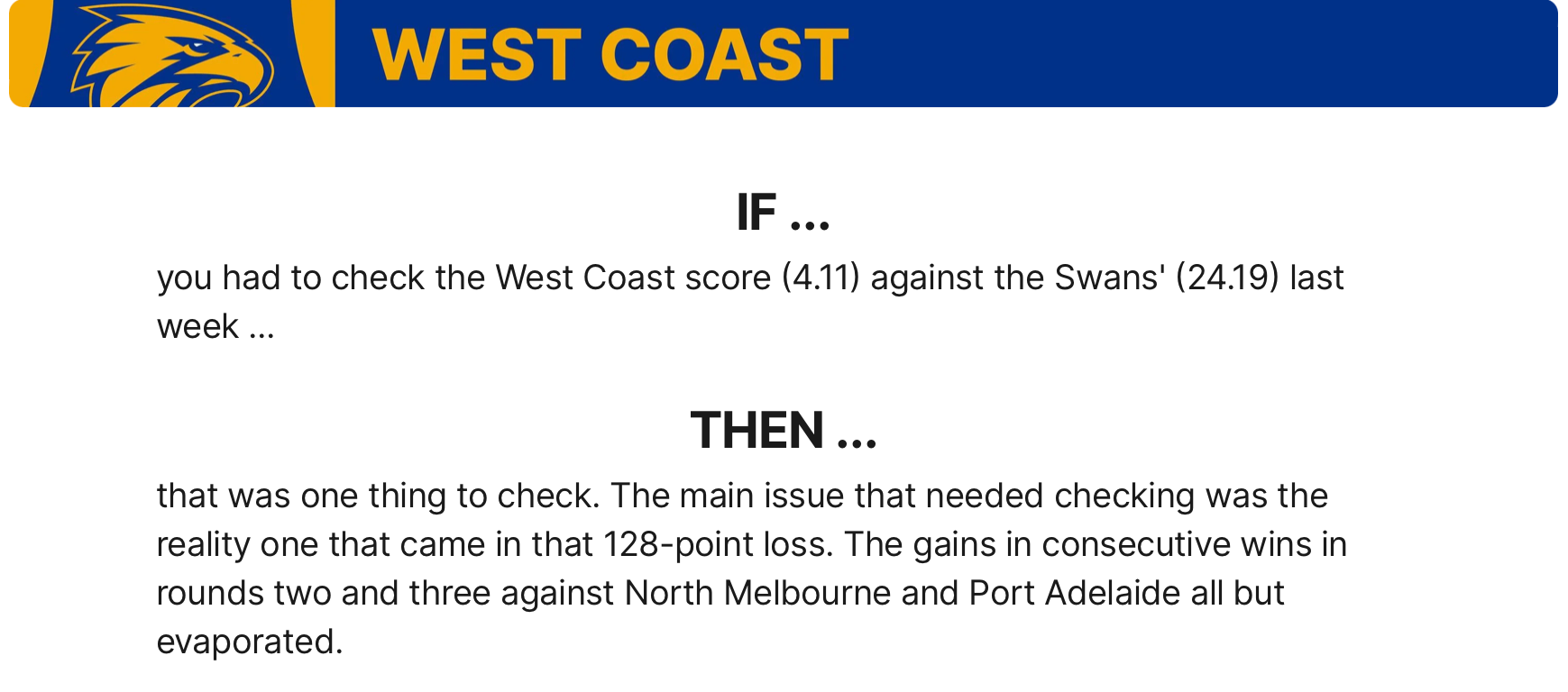
Sliding doors? No. An affront to the English language? Absolutely.
But is this really Barrett’s fault?
After all, how can you write a Sliding Doors column when we only ever know one side of the story? ‘If A then X, if B then Y’ isn’t exactly a winning formula for a weekly columnist. Nobody can predict the future, and reflecting on the past only shows us what we already know has happened - everything else is guesswork.
In truth, the only sliding doors moment humans have ever been able to concretely prove is that Kermit the Frog’s birth did, in fact, cause 9/11. So where does that leave footy fans?
While we’ll never know what would have happened if Buddy signed with the GIANTS, and even the best data in the world doesn’t guarantee us a perfect weekend of tipping, I think there’s scope to use what we’ve seen to identify emerging trends that could have a big impact on the footy world.
Sure, it’s still playing a little fast and loose with the premise, but I hope you’ll agree it’s an improvement on what’s being served up elsewhere (and, more importantly, that it’s a legally distinct column - being sued by SEN’s finest isn’t on my bucket list).
If: Rhett Bazzo is the missing piece in the Eagles backline
Then: Andrew McQualter can expect a contract extension
Rhett Bazzo is an unassuming West Coast key defender who you may be reading about for the first time right now. Drafted 37th overall in the 2021 draft, Bazzo’s early career has been defined by a torrid time on the field (entering 2026 on a streak of 1 win in 26 games) and personal tragedy off it. But the wheel is starting to turn.
His season debut in Round 10 coincided with the Eagles upset victory over GWS. Bazzo retained his place for the narrow Round 11 defeat against Scott Pendlebury Collingwood, and racked up a career high 16-disposals in the Round 12 win over Essendon. Two wins in three for a player who’d previously celebrated twice since his 2022 debut. Dizzy heights.
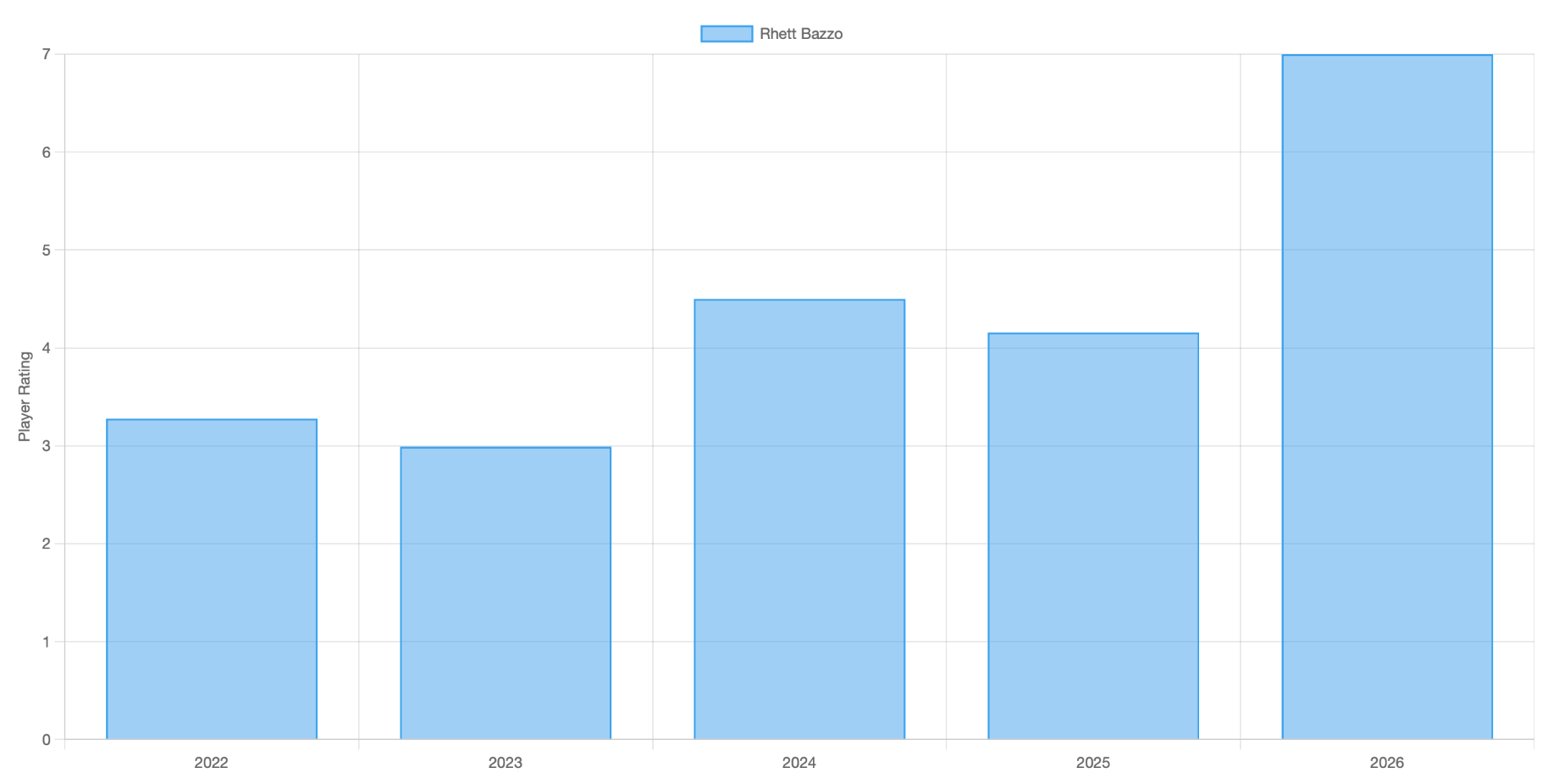
Rhett Bazzo: average player rating by season
But, as with most low profile key defenders, it’s not really about Rhett Bazzo; it’s about what his presence opens up elsewhere. With Jeremy McGovern medically retired, Tom Barrass busy being swung forward at Waverley, and the heir apparent Harry Edwards having played just 25 minutes this year due to three seperate concussions, West Coast’s defensive structure has been crying out for a reliable, do-your-job defender.
They’d kicked the tires on ex-Sun Sandy Brock to mixed effect, traded for former Richmond late bloomer Tylar Young, and been buoyed but ultimately unrewarded by the inspired endeavours of the tireless Reuben Ginbey.
Elsewhere in the backline, former shutdown aficionado Brady Hough had completely lost his mojo. Tom McCarthy, envisioned to be the Eagles’ primary ball user off half-back, had spent a frustrating portion of the season with more defensive responsibility than you’d like. But Bazzo’s inclusion has settled the Eagles defensive unit, opened up some magnet moves further afield, and brought the best out of the more recognisable names alongside him.
Take McCarthy, West Coast’s 1A rebounding weapon who, in the past three weeks, has set career highs for score launches and score involvements across separate games. Against Collingwood, he posted a career high player rating (17.9). The following week, he bettered it (19.7), set his new benchmark for ball use (8.7), and drifted forward to kick his first career goal.
In Round 10, Brady Hough shook off an aimless start to 2026, spending less time in Bazzo’s backline and more time with a tagging role on Finn Callaghan. Hough’s 27 percent CBA attendance was a season high-water mark, and he consistently picked up Callaghan post-restart to lock onto one of GWS’ most dangerous weapons.
Callaghan was held to just 288m gained, his lowest output since 2024, and the Giants limped to a season low 5065m gained as a unit. Hough backed up his tagging role the following week, in the second lowest rated game of Scott Pendlebury’s career (2.5).
Curtailing opposition ball movement has been a staple of the Eagles during Bazzo’s recent tenure, with the club’s three best efforts for the year coming in each of his three games. From Rounds 10-12, opponents have averaged 5493m metres gained against West Coast; around 200m per game better than this year’s #1 ranked team (North Melbourne, 5672m). In the games without Bazzo, it’s 6357m (100m worse than the 18th ranked Geelong).
GWS (14.6 per cent) and Collingwood (15.0 per cent) each had their worst day of the year moving the ball from defensive 50 to forward 50. For Essendon, it was a season low in defensive half to F50 (23 per cent).
So, back to sliding doors. The big ‘if’ here is how much of this improvement is down to Bazzo’s inclusion. Certainly his selection has facilitated some personnel creativity, with Hough’s now permanent tagging role bolstering the Eagles’ midfield hand and manic MiniBall pressure, McCarthy’s increased offensive involvement allowing for more ball retention and deeper field position, running-mate Reuben Ginbey recognised with 11 coaches votes, and the eye test saying Tylar Young looks more settled in his defensive duties (while also racking up career best output with ball in hand).
But it’s also come against opposition that ranges from middle of the road to historically bad.
Will this all be found out when the real teams come to town, or can the Eagles continue their newfound solidarity against better opposition? If they can, Andrew McQualter will be signing on the dotted line long before he enters the final year of his contract in 2027.